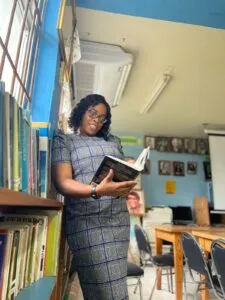
As a veteran teacher of over 20 years across numerous subjects and schools, Audreen J. Moore brings compassion, commitment, and a service oriented approach to her teaching. In spite of numerous challenges facing the profession, Audreen navigates meeting the needs of her students with the nuance and care of a dedicated educator that sees the humanity in each of her students. She empowers her students to know “their choices, attitudes, and actions matter, and they have a responsibility to respect others, challenge injustice, and contribute positively to the world around them.”
AFS: Hi Audreen, would you please introduce yourself and share a little about your teaching position?
Audreen: I am a secondary school educator in Jamaica, a Caribbean island nation. I currently teach at Vere Technical High School, a public secondary school in Clarendon, one of Jamaica’s 14 parishes.
My current teaching responsibilities include Social Studies at Grades 10 and 11 and Caribbean Studies at Grade 13 (sixth form). I prepare students for external examinations administered by the Caribbean Examinations Council (CXC).
AFS: How did you become a teacher?
Audreen: Interestingly, teaching was not a profession I initially chose for myself. In fact, I sometimes jokingly say that I was practically forced into it!
I come from a family of educators, and after completing high school, I was quite content to enter the workforce rather than immediately pursue tertiary education. My mother and siblings, however, had other ideas. To them, the thought of my settling into employment without pursuing further education was almost unthinkable. Their solution was simple: “At least go to Teachers’ College. If you finish and discover that teaching is not for you, you can always pursue something else.” So, somewhat reluctantly, I went to Teachers’ College. Twenty-two years (and counting) later, having just begun my 23rd year in education, I am still in the classroom, and that “something else” has yet to materialize!
When I encounter a child who is visibly sad, a student who is going hungry, or a young person whose defiance prevents them from recognizing their own potential, I feel compelled to do something. I cannot simply look the other way. Perhaps that explains why, despite my many declarations that I am going to walk away from teaching, I still find myself in the classroom.
At heart, I am a service-oriented person. I believe that my purpose extends beyond any particular profession or job title. I see myself as a servant of the people, and over the years, I have discovered that many of the people who most need to be served are sitting in our classrooms.
AFS: Can you share a little about your students with us?
Audreen: Having taught in both public and international school settings in Jamaica, I have discovered that although students’ socioeconomic circumstances, exposure, and access to educational resources may differ, children are fundamentally more alike than they are different.
My students reflect Jamaica’s rich cultural heritage. Most are of African descent, although Jamaica is a multicultural society with influences from European, Indian, Chinese, and other ancestral groups. Christianity is a prominent religious influence, but students also come from families with different religious beliefs and practices.
English is Jamaica’s official language and the principal language of instruction, while Jamaican Creole, commonly called Patois, is widely spoken in everyday communication. This linguistic reality presents both opportunities and challenges in education. Some students are articulate and expressive in their everyday language but struggle to communicate their ideas clearly in formal written English, particularly when responding to examination questions.
My students also come from diverse family structures and socioeconomic backgrounds. While some enjoy considerable family support and access to resources, others face financial hardship, food insecurity, inadequate learning materials, and challenging home circumstances. Some live with both parents, others with a single parent, grandparents, or extended family members.
These realities sometimes manifest in the classroom through poor social skills, behavioural difficulties, emotional distress, inconsistent attendance, limited parental involvement, and challenges with written communication. As teachers, we must recognize that what appears to be indiscipline or a lack of interest in learning may sometimes reflect difficulties extending far beyond the school gates.
AFS: What about your current teaching context – what is your school like?
Audreen: I currently teach at Vere Technical High School. As its name suggests, it offers a combination of academic, technical, and vocational education, allowing students to develop theoretical knowledge alongside practical skills.
Jamaica’s secondary education system generally spans Grades 7 to 11, with students typically sitting the Caribbean Secondary Education Certificate (CSEC) examinations at the end of Grade 11. Vere Technical also operates a sixth-form programme comprising Grades 12 and 13, providing opportunities for students to continue their education beyond the usual five years of secondary schooling.
The school also offers a technical sixth-form pathway for students who may not yet meet the academic requirements for the conventional CAPE programme. These students may improve previous examination results, pursue additional academic subjects, and undertake technical or vocational studies leading to qualifications such as CSEC and City & Guilds certification.
Beyond academics, Vere Technical places considerable emphasis on sports and agriculture. The school also has residential facilities that accommodate students involved in these areas, allowing them to remain on campus while pursuing their educational and extracurricular interests.
What I find particularly significant about this type of institution is its recognition that students do not all learn at the same pace, possess the same strengths, or follow identical educational pathways. By combining academic education with technical, vocational, agricultural, and sporting opportunities, the school provides different avenues through which students can discover their strengths, develop their abilities, and prepare for meaningful participation in society.
AFS: What is a challenge that you feel many teachers in your area have to face?
Audreen: The challenges facing teachers in Jamaica are numerous, and they vary considerably depending on the school environment. However, if I were to identify one issue that is increasingly influencing teachers’ willingness to remain in the profession, it would be the erosion of respect for educators and the growing challenges associated with student behaviour and discipline.
Jamaica’s secondary education system includes schools historically categorized as traditional and non-traditional high schools. Traditional high schools have generally been more academically selective and may experience fewer persistent disciplinary challenges, although they are certainly not immune to them. In many non-traditional and technical high schools, however, teachers frequently contend with students who enter secondary education academically underprepared, alongside increasingly complex behavioural and social challenges.
Yet, I believe the problem extends far beyond the classroom. Schools are microcosms of society, and what we witness within their walls often reflects broader changes in family life, community relationships, social values, and attitudes toward authority and personal responsibility.
There was a time when teachers could reasonably expect parents to work alongside them in addressing a child’s academic underperformance or misconduct. Today, although many parents remain committed and supportive, some appear to place almost the entire responsibility for their children’s educational progress on teachers, even when there is limited supervision of homework, reading, or other learning activities at home.
The relationship between home and school can sometimes become confrontational rather than collaborative. Teachers may find themselves being questioned, blamed, or even verbally abused for outcomes that require the combined efforts of students, parents, schools, and the wider community.
Student indiscipline has also become a particularly troubling issue. Defiance, verbal disrespect, disruptive behaviour, and, in some instances, threats to teachers’ personal safety can make the classroom an emotionally exhausting environment. When teachers must spend considerable time managing behaviour, valuable instructional time is lost, and the learning opportunities of other students are compromised.
AFS: Can you share with us a success story or moment that made you feel valued as an educator?
Audreen: One particularly meaningful chapter of my professional journey was my time at Tivoli Gardens High School, located in an inner-city community in Kingston, Jamaica. I was part of the team that initiated the school’s sixth-form programme, creating opportunities for students to pursue advanced secondary education beyond Grade 11. Knowing that the programme continues today is itself a tremendous source of satisfaction.
I remember preparing my first five students for Economics examinations. Four of the five were successful. The fifth experienced significant mental health challenges during the programme, which may have affected his performance. Although I had hoped for a 100% pass rate, achieving four passes out of five was an important milestone.
What made that period particularly memorable was the environment in which we were working. In 2010, the Tivoli Gardens community experienced violent unrest during a major security operation in Kingston, commonly known as the Tivoli incursion. It was a frightening period for residents, including students who were preparing for external examinations while fearing for their safety.
As educators, we found ourselves doing far more than teaching subject content. We were helping students navigate uncertainty, making alternative examination arrangements, and finding ways for them to complete their examinations despite the disruption.
One student stands out in my memory. Geography was among her greatest academic challenges. Although I was not her Geography teacher, I became deeply involved in supporting her preparation, including helping her put her written work together. During that difficult period, I even welcomed her into my home. She eventually had to sit her CSEC Geography examination at an alternative centre. Despite everything, she earned a Grade One, the highest grade awarded in the examination. That achievement meant so much to me, not because I had taught her Geography, but because I had witnessed her struggles and had been able to play a part in helping her overcome them. And that has always been my approach to teaching. I do not see my responsibility as ending with the subjects assigned to me. When I connect with students, I want them to succeed on every front.
AFS: Have you tried to incorporate Global Citizenship Education (GCED) into your classroom?
Audreen: One of the advantages of teaching subjects such as Social Studies, Caribbean Studies, Sociology, Religious Education, and Health and Family Life Education is that Global Citizenship Education (GCED) is naturally embedded in much of what we teach. These subjects provide countless opportunities to help students understand not only who they are and where they come from, but also their place in an increasingly interconnected world.
Whether we are examining global poverty, social inequality, migration, cultural diversity, human rights, environmental sustainability, or the relationships between individuals and societies, I consistently encourage students to look beyond their immediate circumstances and consider how their lives connect with those of people in other parts of the world. In fact, it would be difficult for me to identify just one lesson in which I have incorporated Global Citizenship Education because its principles are so deeply interwoven into the subjects I teach.
One particularly memorable activity took place while I was participating in an AFS professional learning programme alongside educators from different parts of the world. I engaged my Grade 7 students in an activity exploring Jamaica’s multicultural heritage through our national motto, “Out of Many, One People.”
Students represented different ethnic groups whose ancestors contributed to the development of Jamaican society. They dressed in clothing inspired by the traditional attire associated with these groups and researched and presented information about their histories, customs, foods, languages, and other cultural contributions. Through the activity, students explored how people originating from different parts of the world helped shape the unique Jamaican identity we celebrate today.
The experience also created opportunities to discuss cultural appreciation, respect for differences, and the importance of recognizing the contributions of diverse peoples to a shared national identity. For me, this was more than a lesson about Jamaica’s history. It was an opportunity to help students recognize that cultural identity is shaped by human interaction, migration, adaptation, and shared experiences across geographical boundaries.
I also try to encourage students to think critically about social issues rather than simply memorize information for examinations. When we discuss poverty or social inequality, for example, I want them to consider not only what these concepts mean but also why such conditions exist, how they affect people’s lives, and what responsibilities individuals, communities, and governments have in addressing them.
Ultimately, my approach to Global Citizenship Education is to help students understand that while they are proudly Jamaican, they are also members of a wider human community. Their choices, attitudes, and actions matter, and they have a responsibility to respect others, challenge injustice, and contribute positively to the world around them.
AFS: How have your students responded to GCED?
Audreen: My students have generally responded positively to Global Citizenship Education, particularly when they are given opportunities to connect abstract concepts to real-life experiences.
With older students, particularly those studying Caribbean Studies, Sociology, Economics, Management of Business, and Entrepreneurship, I have observed a growing appreciation for the practical implications of global interconnectedness.
For example, when discussing international business operations, students come to recognize that something as seemingly straightforward as scheduling a telephone call requires an awareness of time zones, cultural expectations, and professional etiquette. Midday in Jamaica may be the middle of the night for a business partner elsewhere in the world. What appears convenient from one person’s perspective may be intrusive or inappropriate from another’s.
These experiences encourage students to move beyond simply knowing that differences exist to understanding why those differences matter and how they should influence our interactions with others. In subjects such as Sociology and Caribbean Studies, students are also encouraged to examine issues of poverty, inequality, identity, and social justice through critical discussion. As they develop higher-order thinking skills, they become better able to connect global issues with their own lived experiences and recognize the wider implications of social and economic decisions.
For me, one of the most encouraging responses to Global Citizenship Education is seeing students develop a greater awareness that their actions do not exist in isolation. They begin to appreciate that being a responsible global citizen requires more than knowledge of other countries and cultures. It calls for empathy, respect, ethical judgment, and a willingness to consider perspectives beyond one’s own. That growing awareness is itself a meaningful educational achievement.
AFS: What is one instructional method you find very effective that you would recommend to other teachers?
Audreen: If there is one instructional approach I would recommend to fellow educators, it is embracing inclusive teaching through the use of multiple methods of instruction.
The modern classroom is increasingly diverse, not only in terms of students’ academic abilities, interests, and socioeconomic backgrounds, but also in the range of learning and developmental needs teachers encounter.
One approach I find particularly useful is presenting information through multiple formats and providing students with varied opportunities to engage with and demonstrate their understanding. For example, in my recent Social Studies and Caribbean Studies lessons, I have combined PowerPoint presentations, printed handouts, guided discussions, matching exercises, chart-completion activities, multiple-choice questions, and structured writing tasks. I also share supplementary educational videos through Google Classroom, allowing students who have access to revisit concepts outside regular lesson time.
While teaching the different ways of defining the Caribbean, I incorporated map work to help students visualize and apply geographical concepts that might otherwise remain abstract.
These activities serve different instructional purposes. Visual presentations help introduce and illustrate concepts; matching exercises reinforce connections between terms and meanings; multiple-choice questions allow students to check their understanding; and structured writing activities provide additional support for students who struggle to organize and express their ideas independently.
Importantly, the objective is not to lower academic expectations but to provide different pathways through which students can work toward the same learning goals. This approach is consistent with the principles of Universal Design for Learning (UDL), which encourages teachers to provide multiple means of engagement, representation, and action or expression.
Of course, varied instruction cannot replace specialized support for students who require individualized intervention. Teachers need appropriate training, resources, and professional assistance to make inclusive education genuinely effective. However, even within resource-constrained environments, we can make meaningful adjustments to how we teach.
My advice to fellow educators is to avoid becoming so attached to one instructional method that we overlook the students for whom that method is not working. Inclusive teaching begins when we stop expecting every child to fit neatly into one instructional approach and start making our teaching flexible enough to accommodate the diversity before us.
AFS: If you could give one piece of advice to a new teacher starting their career next school year, what would you say?
Audreen: My advice to a new teacher would be simple: Bloom where you are planted, but never allow the conditions of the soil to determine the limits of your growth.
Entering the classroom for the first time can be daunting. You may encounter limited resources, challenging student behaviour, discouraging attitudes, and environments where exemplary leadership is not always as visible or accessible as you might hope. But I would encourage you not to accept the status quo simply because it is what you find around you.
Do not become comfortable with mediocrity because others have settled for it. Do not turn a blind eye to a child’s needs because someone else has chosen to look away. And never allow another person’s disappointment, frustration, or abandoned dreams to determine what is possible for you.
Be intentional about your work. Give it your best, even when circumstances are less than ideal. Be willing to question ineffective practices, explore new approaches, and become the catalyst for positive change within your school community.
And remember, we are educators in an increasingly interconnected world. You do not have to leave your country to expand your professional horizons. Technology allows us to connect with educators across continents, exchange ideas, learn from their experiences, and discover innovative approaches to challenges that may be remarkably similar to our own.
Somewhere in the world, another teacher may be facing the very problem you are struggling to solve. Their experience could provide the insight you need, just as your own experiences may inspire someone else. So, build professional relationships, remain curious, embrace lifelong learning, and never stop looking beyond the limitations of your immediate environment.
Audreen welcomes questions, comments and collaboration from other educators around the world via email: [email protected], via whatsapp +876 4295479 and/or by social media sites (Audreen Moore)