
Throughout Ahmed Mohamed Elhady Hassan’s career as an educator he has believed that “effective education evolves with its context while retaining a clear purpose.” Ahmed strives to empower students to think independently, solve problems, and use their knowledge to improve their lives and communities. Learning should not just be about content mastery, but also what can be done to positively contribute to society.
AFS: Hi Ahmed! Would you please introduce yourself to our readers?
Ahmed: I am currently a mathematics educator in the United Arab Emirates, applying STEM-oriented instructional approaches and relevant curriculum standards to make mathematics more engaging, meaningful, and connected to real-world applications.
AFS: How did you find a career as an educator?
Ahmed: I have been working in education since 2005. My motivation has always been the belief that education should empower students to think independently, solve problems, and use their knowledge to improve their lives and communities.
My journey began with mathematics teaching in Egyptian public schools. As I gained experience, I realized that students develop a deeper understanding when they can apply mathematical concepts to meaningful situations rather than simply memorize procedures.
This realization led me to specialize in STEM education through a professional diploma at the American University in Cairo, followed by a master’s degree in STEM Curriculum Design at Suez Canal University, which I completed with distinction. I am currently pursuing a Ph.D. in STEM Curriculum Design, researching heutagogy-based professional development in STEM mathematics education.
My career has since expanded into school leadership, curriculum implementation, teacher professional development, and Capstone project supervision. I also earned the STEM.org Certified Master Trainer credential, which supports my commitment to strengthening STEM teaching and learning.
AFS: Can you tell us about your learners from your different roles?
Ahmed: My students have come from diverse educational and social backgrounds in Egypt and, more recently, the United Arab Emirates. I am working within the UAE educational context, where I aim to create an inclusive environment that encourages participation, collaboration, and respect for different perspectives.
My previous work across public schools, STEM schools, Egyptian Japanese Schools, and technical education institutions exposed me to learners with different interests, abilities, and aspirations. Some students are especially motivated by scientific inquiry and mathematics, while others excel when they can design, build, investigate, or solve practical problems.
AFS: Could you elaborate more on the context for your evolving role as an educator over the years?
Ahmed: I worked in public education before joining the STEM school system, where I taught mathematics, supported school leadership, and contributed to interdisciplinary Capstone projects. I then worked with the Egyptian Japanese Schools Program Management Unit, supporting instructional improvement and project-based learning across 51 schools.
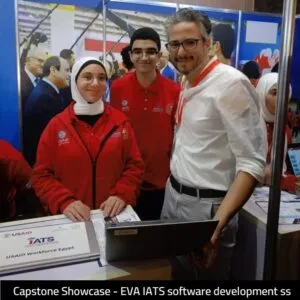
Later, through the USAID Workforce Egypt Project, I led Capstone board activities and supported implementation across 10 International Applied Technology Schools. These schools emphasize competency-based education and connect classroom learning with technical skills and labor-market needs. My subsequent work has included Capstone development and supervision across 25 schools.
AFS: How do you support teachers to meet the many challenges of their profession?
Ahmed: One significant challenge is helping teachers balance curriculum requirements and examination preparation with the development of deeper competencies.
In mathematics, students may learn procedures successfully but still struggle to understand when and why to apply them. STEM-oriented teaching can address this gap, but it requires careful lesson design, meaningful contexts, effective formative assessment, and opportunities for students to explain their reasoning.
Educational innovation must be practical and adaptable. Teachers need appropriate resources, collaboration with colleagues, and assessment methods that recognize both academic understanding and the application of knowledge.
I aim to address this challenge by combining explicit mathematics instruction with problem-solving, student discussion, collaborative activities, and connections to real-world contexts.
AFS: Can you share with us a success story or moment that made you feel valued as an educator?
Ahmed: One of the most significant achievements in my career was contributing to the design and implementation of an innovative Capstone methodology for Egypt’s International Applied Technology Schools through the USAID Workforce Egypt Project.
Unlike simply supervising student projects, my role involved contributing to the design of a structured educational model that could be implemented across technical schools. To my knowledge, this represented a new approach in the technical-school context in Egypt, introducing a systematic way to connect competency-based education with interdisciplinary problem-solving, innovation, and authentic labor-market challenges.
I also contributed to translating the methodology into practice through structured implementation processes, including Capstone guides, assessment rubrics, teacher and facilitator support, milestone monitoring, technical panel reviews, and student project exhibitions.
What made this experience particularly meaningful was the opportunity to help establish a structured approach through which technical education could move beyond demonstrating isolated technical skills toward developing students who can identify real problems, design solutions, evaluate their feasibility, and communicate their value.
Another important milestone was extending my collaboration with fellow educators beyond the AFS Global STEM Educators experience through the Global Classroom Connections (GCC) Pilot 2026.
In the GCC initiative, I helped mobilize student participation from 2 schools from Egypt, presented the capstone project overview and submission requirements, and supported the technical and operational implementation by setting up the portal used to receive project information and student submissions.
The initiative connected students from different countries, encouraging them to identify challenges in their communities, link them to the United Nations Sustainable Development Goals (SDGs), and propose practical solutions.
What made this experience especially valuable was seeing how professional connections established through AFS could develop into meaningful international collaboration. It reinforced my belief that educators can extend their impact beyond their own classrooms by working together to create opportunities for students to learn, share ideas, and contribute to positive change.
AFS: It seems like you have extensive experience incorporating Global Citizenship Education into your practice. What are some examples of how you have done that?
Ahmed: I incorporate the principles of Global Citizenship Education by connecting subject knowledge with real-world challenges and helping students understand their responsibilities to their communities and the wider world.
In my current UAE mathematics classroom, I use STEM-oriented approaches to encourage students to reason mathematically, collaborate, examine problems from different perspectives, and consider how mathematical knowledge can inform decisions about everyday issues.
My previous experience in STEM education and Capstone project supervision has allowed me to extend these principles to interdisciplinary challenges involving sustainability, responsible resource use, environmental protection, technological innovation, and community needs. These themes can be connected to the United Nations Sustainable Development Goals, including Quality Education, Decent Work and Economic Growth, Industry, Innovation and Infrastructure, and Responsible Consumption and Production.
My work with Egyptian Japanese Schools also strengthened my appreciation of student responsibility, collaborative learning, and the social dimensions of education. In technical education, I helped connect student learning with workplace expectations and the needs of local communities.
This approach connects STEM principles with Global Citizenship Education by encouraging students to develop responsible, practical, and potentially sustainable solutions to real-world challenges. It also helps them recognize that technical competencies can be used not only for employment, but also to create value for communities and contribute to sustainable development.
I also hold the AFS Global STEM Educators Global Competence Certificate, which complements my professional interest in global competence and STEM education.
For me, Global Citizenship Education is not an additional topic that must be taught separately. It is a way of designing learning experiences that encourage students to think critically, respect diverse perspectives, act responsibly, and use their knowledge to contribute to a more sustainable and inclusive world.
A practical example of this approach was my contribution to the Global Classroom Connections (GCC) Pilot 2026, an international initiative I worked on with fellow educators following our AFS Global STEM Educators experience.
This experience demonstrated how Global Citizenship Education can move beyond theory into practice. Students had opportunities to connect local issues with global priorities, learn from perspectives beyond their own communities, and recognize that they can contribute to positive change regardless of where they live.
AFS: How do you think students respond to Global Citizenship Education?
Ahmed: Students often become more engaged when they understand the purpose of what they are learning and see how it relates to their lives and communities.
In mathematics, meaningful problems and collaborative activities give students opportunities to explain their reasoning, compare different strategies, learn from mistakes, and recognize that there can be multiple ways to approach a challenge.
My experience has also shown me the educational value of student ownership. When students investigate authentic problems, take responsibility for specific tasks, and present their findings, they have opportunities to develop communication, teamwork, resilience, and respect for others’ contributions.
I believe this is an important connection between STEM education and global citizenship: students learn not only how to solve problems, but also how to work with others and think about whom their solutions may benefit.
AFS: What teaching practices would you recommend to other educators?
Ahmed: I recommend combining problem-based and project-based learning with clear learning objectives, explicit instruction, formative assessment, and structured student collaboration.
In mathematics, I often find it effective to begin with a meaningful problem, help students identify the mathematical ideas involved, and then guide them through the concepts and procedures they need to develop a solution. Students should have opportunities to explain their reasoning, compare strategies, and reflect on their mistakes.
For longer interdisciplinary challenges, the Capstone Project provides a useful structure. Students investigate an authentic problem, apply knowledge from different subjects, develop and test solutions, and communicate their results.
I recommend breaking projects into manageable milestones, assigning clear team roles, using transparent assessment rubrics, and providing regular feedback. Teachers should assess not only the final product but also mathematical understanding, evidence-based reasoning, collaboration, and individual contributions.
My STEM.org Certified Master Trainer qualification reinforces my commitment to effective STEM practice and teacher development. However, the most important principle is that no single method replaces good teaching. Effective educators select and adapt strategies according to their students, curriculum objectives, and classroom context.
I also recommend extending project-based learning beyond the classroom through international collaboration.
This illustrates how a well-designed project can combine subject knowledge, critical thinking, communication, creativity, and global competence. It also gives students an authentic audience for their work and encourages them to consider different perspectives when developing solutions.
My experience with both Capstone projects in technical education and international student collaboration has reinforced my belief that students learn more deeply when they apply knowledge to meaningful challenges and communicate their ideas beyond the classroom.
AFS: If you could give one piece of advice to a new teacher starting their career next school year, what would you say?
Ahmed: My advice is: Teach students how to think then apply, not just what to remember.
Build strong relationships with your students, understand their needs, and create a classroom where asking questions, exploring ideas, making mistakes, and learning from others are all valued.
Develop your subject knowledge, but also learn how to make it meaningful. Connect lessons to authentic problems, encourage collaboration, and give students opportunities to apply what they learn.
Remain a learner yourself. Seek professional development, collaborate with colleagues, reflect on your teaching, and be willing to adapt your methods when students need something different.
Ultimately, our responsibility is not only to help students succeed academically, but also to equip them with the knowledge, confidence, and sense of responsibility they need to contribute positively to society.
Ahmed welcomes fellow educators who are interested in STEM education, project-based learning, and Capstone projects to connect via email at [email protected]