
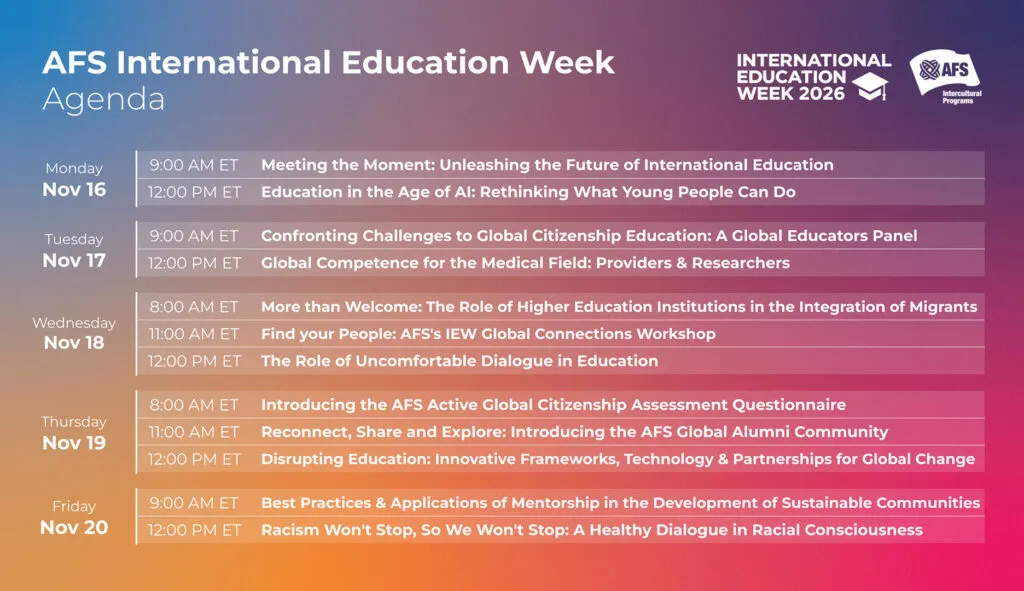
To mark International Education Week (IEW) 2026, AFS Intercultural Programs hosted a week-long virtual webinar series this November. As educational systems navigate technological acceleration and persistent inequalities in access while contending with the impacts of polarization, the series was an excellent opportunity for AFS to convene global educators, researchers, practitioners, and youth changemakers to address those pressing issues.
Over five days, more than 1,000 live participants and 1,200 additional asynchronous viewers across 110+ countries engaged in 10 content sessions, working to advance international education and connect across differences. AFS partnered with more than 20 organizations and educational institutions to deliver a comprehensive educational program all week long.
Global Education in Focus: Themes of the Week
Across the series of webinars, several central topics emerged that translated educational theory and ideas into calls to take action.
- Cultivating Shared Humanity: The discussions during our opening session framed international education as a necessity for human connection rather than a matter of international travel. The President and CEO of AFS Intercultural Programs, Daniel Obst, stressed shifting from passive cultural awareness to active global citizenship through “relational intelligence,” the capacity to build trust and navigate differences across fragmented societies. Monika Froehler, CEO of the Ban Ki-moon Foundation, highlighted five core competencies needed in modern curricula: communication, human creativity, critical thinking, conflict resolution, and curiosity. Measuring the impact of international education and demonstrating its value to policymakers was underscored by Chris Arnold, Founder of Made Impact, and Jonathan Modernel, Chief of Staff at the Buenos Aires City Ministry of Education’s Unit for Comprehensive Evaluation of Educational Quality and Equity.
- Protecting Youth Agency and Ethics in the Age of AI: Examining technology’s role in an open conversation, youth leaders emphasized that education must focus on human judgment rather than allowing automated tools to replace critical thinking. Allegra Cuomo, founder of InnoEthics, argued that AI must remain an assistive tool that preserves student agency. Gunay Bayramova of the University of Rochester cited research showing that unguided AI access causes learners to “offload” cognitive struggle, whereas structured guidance augments understanding. John Ofori, CEO of Rethink Africa Intelligence, called on youth to critically question algorithmic outputs and rectify datasets that underrepresent indigenous languages. AFS Cultural Vistas Fellow Yeseul Bai surfaced that AI functions well in less than 2% of the world’s languages, underscoring that technology cannot replace genuine exchange.
- Grounding Global Citizenship in Local Realities: In a dynamic educators’ panel, practitioners examined how to adapt global learning to real-world classrooms. Nigerian educator Joy Usomimeh Ameh explained that fostering global citizenship requires intentionality rather than complex technology, urging teachers to link global issues directly to local community experiences. Rawan Saqfalhett, teaching in the West Bank, shared how virtual exchanges bridge severe mobility restrictions to bring global perspectives to students. Peruvian educator Jhon Pando emphasized teaching students how to think rather than what to think, grounding lessons in Indigenous Andean philosophies such as Ayni (mutual reciprocity) and Sumak Kawsay (harmonious community living).
- Embedding Intercultural Competence & Racial Consciousness Across Institutions: Extending global competence into healthcare and higher education emerged as an institutional priority for equipping individuals and communities to navigate diverse, complex realities. Discussing medical environments, James Trelstad-Porter of The Hormel Institute, The University of Minnesota and Beth West of Northwell Health highlighted how cultural dynamics invisibly affect clinical care and research teams, advocating for self-reflection and structured models like the AFS Global Competence Certificate. In higher education, Dr. Darla K. Deardorff and UNESCO’s Raffaela Iuliano presented their publication More than Welcome, detailing a multidirectional integration framework for refugee and migrant learners, supported by student advocate Ornela Meri’s call to dismantle structural barriers to belonging in university spaces. And Dr. Tony Hudson concluded the transformative week with a most powerful invitation to each of us as leaders and educators to engage in healthy cross-racial dialogue, build the capacity for stronger collaborations, and work towards a sustained systemic change. The call to action is to engage in racial equity work -now- to realize our mission of peace, justice and greater understanding.
- Beyond these core themes, the week also featured sessions on AFS’s new evaluation and assessment tool based on our educational framework and Soliya’s guided dialogue model. Rounding out the program, speakers examined purposeful disruption and the vital role of mentored learning in anchoring innovation in human relationships.
In Their Own Words: Impact in Action
Direct feedback from participants reflected the resonance and practical value of these conversations across borders:
“The most valuable aspect was learning how to transform a simple ‘welcome’ into genuine, lasting integration. Dr. Darla Deardorff’s Intercultural Competence framework and the practical insights on empathy, active listening, and systemic support gave me a whole new perspective on building inclusive communities.”
Aylin Mahmudova
“In an era of rapid AI advancement and shifting geopolitical dynamics, the core value of international education lies in cultivating uniquely human competencies, such as empathy, trust, and relational intelligence by using technology as a bridge rather than a substitute for authentic, face-to-face, people-to-people connections.”
Diah Gayuh Larasati
“As a student who dreams of studying abroad, this webinar was both informative and inspiring. It encouraged me to explore more opportunities, step out of my comfort zone, and work harder toward my future goals.”
Otgonsukh Erdenezul
Join the Movement for Active Global Citizenship
International Education Week 2026 affirmed that the future of education depends on cultivating human connections that bridge divides. By uniting experts from across sectors with youth action, AFS continues to expand access to transformative learning and empower active global citizens worldwide.
- Watch the Sessions On-Demand: Revisit full webinar recordings and panel discussions on the AFS IEW 2026 video hub and official YouTube channel.
- Explore the Educational Framework: Learn about core competencies through the AFS Framework for Active Global Citizenship.
- Connect with AFS locally: AFS has a worldwide presence, and we would love to welcome you onboard. Find our office closest to you here.