
Reflections on Joy, Equity, and Respectful Disruption in International Education
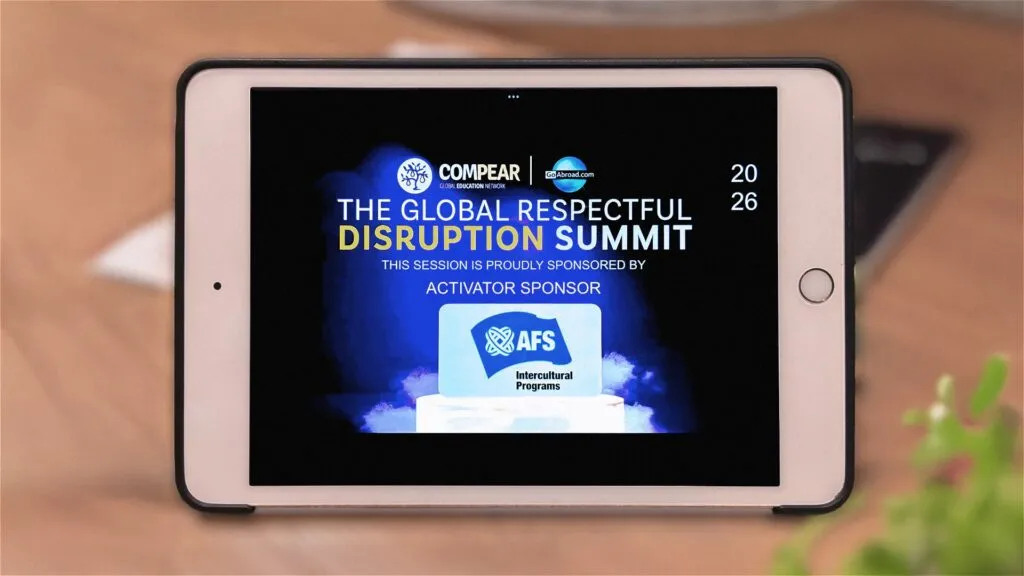
The 5th Annual Global Respectful Disruption Summit (GRDS 2026) felt like an invitation to step onto a moving journey with no fixed blueprint, only a shared willingness to question what international education has normalized, and what it might become instead.
Educators, practitioners, and advocates from across the world gathered around a provocative premise:
What if global education stopped treating neutrality as protection and began treating reflection as responsibility?
As a sponsor of GRDS 2026, AFS joined that journey not as an observer, but as part of a collective effort to strengthen the field of international education through more equitable, reflective, and courageous practice. Fifteen representatives from across the AFS network—including colleagues from Canada, Egypt, Latin America, the United States, and international staff—contributed perspectives shaped by different contexts but connected through a common commitment: exploring how global learning can evolve to better serve an increasingly complex world.
What followed was not a conference designed to reaffirm familiar approaches or celebrate comfortable consensus.
It was a space for wrestling with harder questions:
- Equity and belonging.
- The language we inherit.
- Silence, power, and whose perspectives remain centered.
- And ultimately, what leadership in international education may need to become.
Because the invitation was never neutral. Its direction was always toward something deeper:
A stronger field. More honest conversations. And a future of global education shaped not only by mobility across borders, but by the courage to examine the systems beneath them.
Along the way, several reflections emerged, not as conclusions, but as signals pointing toward where international education may need to go next.
1. What if joy is not a luxury, but a strategy?
Conversations about equity and systemic change often emphasize struggle, urgency, and repair. While necessary, these approaches can become exhausting over time.
One of the most unexpected reflections from the summit proposed something different:
The summit challenged us to reframe joy not as a luxury, but as a radical form of resistance. Joy may not distract from transformation. It may sustain it.
Inspired by perspectives rooted in Queer Wisdom, participants explored the idea that cultivating joy is itself a form of resistance, especially within systems demanding continuous emotional labor from those advocating for change.
For global education, this raises another question: rather than measuring only how effectively learners adapt to new environments, should we also ask how deeply they experience belonging?
Because perhaps intercultural learning is not only about understanding differences intellectually. Sometimes, connection happens through shared humanity before shared analysis.
What if joy didn’t have to be understood across cultures, but could simply be felt?
As international education evolves, cultivating belonging may become just as essential as cultivating competence.
2. Is neutrality truly neutral?
Few concepts generated more reflection than the idea of professional neutrality.
In many institutions, neutrality is associated with diplomacy, objectivity, or professionalism. Yet participants questioned whether remaining neutral in moments of inequity unintentionally reinforces existing systems.
This is not necessarily an invitation toward polarization. Instead, it asks: When does silence become participation?
Global education increasingly operates within contexts shaped by migration, unequal access, geopolitical tensions, and historical power dynamics. Addressing these realities may require moving beyond performative politeness toward courageous, reflective engagement.
“I was struck by how staying ‘neutral’ can unintentionally reinforce the exclusion of underrepresented voices. The Summit pushed me to stop using ‘professionalism’ as a shield to avoid the messy, necessary work of equity.” — AFS Participant Reflection
The challenge may not be choosing between professionalism and advocacy. Perhaps the future requires redefining professionalism itself.
3. Sustainable change may begin with personal commitments, not institutional promises
Large-scale commitments to diversity, inclusion, or equity often struggle because they remain abstract.
One practice explored during the summit involved creating personal Equity Vows, individual commitments connecting professional actions with personal purpose and responsibility.
The underlying idea was simple: transformation becomes more sustainable when equity moves from organizational language into personal identity.
This approach also acknowledges an important reality: individuals and institutions alike encounter moments of hesitation, silence, or missed opportunities.
Progress may depend less on avoiding imperfection and more on building enough courage to revisit those moments honestly.
“Thoughtful prompts, strong facilitation, and a clear call to action that made the work feel urgent and personal.” — AFS Participant Reflection
Meaningful change becomes possible when values move from aspiration into everyday practice.
4. The language of international education deserves scrutiny
Language shapes what feels normal.
Terms frequently used across international education, such as traditional versus non-traditional destinations, may appear neutral but can reinforce assumptions about which regions occupy the center and which remain peripheral.
This raises broader questions: Who becomes the reference point in global education narratives? Whose perspectives define opportunity, mobility, or success?
Decolonizing international education may involve more than revising curriculum.
It may require revisiting everyday terminology and examining whether inherited language still reflects the equitable futures institutions seek to build.
“I believe that the narrative of decolonizing international education challenges the way we do things at AFS in that I don’t think we have these conversations enough about historical power dynamics… [we need to] normalize talking about critical interculturality.” — AFS Participant Reflection
Because words do not simply describe systems. They help sustain them.
5. Disruption does not always look loud
Perhaps one of the most practical reflections emerging from the summit was this: Effective disruption is often quiet.
Transformation frequently happens through policy adjustments, reflective questioning, revised criteria, new partnerships, or expanding who participates in decision-making processes.
This concept, described through Respectful Disruptive Leadership frameworks, suggests that change does not always require confrontation.
“I thought it was a way to make this work accessible for all personality types and that there is always something we can do when faced with injustice.” — AFS Participant Reflection
Sometimes it begins with:
- Asking who benefits from existing systems
- Including historically excluded voices earlier in decision-making
- Revisiting policies that unintentionally create barriers
- Treating learners and communities as co-creators rather than recipients
Small shifts accumulate. Over time, they reshape culture. And eventually, they reshape institutions.
The Path Forward: Staying on the Journey
The Global Respectful Disruption Summit was never meant to be the final stop. If anything, it was a boarding platform for respectful disruption in global education.
The conversations sparked during those days did not end when participants logged off. Across the AFS network, colleagues have already begun a second phase of reflection. continuing discussions, and asking how ideas around equity and respectful disruption might move from inspiration into everyday practice.
Because meaningful transformation rarely arrives all at once.
- More often, it happens in motion.
- In revisiting assumptions.
- In changing inherited language.
- In questioning whose voices remain absent.
- In choosing courage over comfortable neutrality.
And in returning, again and again, to the work of aligning institutions with the futures they hope to create. The journey we were invited into was never neutral. Its purpose was not disruption for disruption’s sake.
It was movement:
- Toward stronger institutions.
- Toward greater accountability.
- Toward a field of international education shaped by deeper belonging, more equitable systems, and a willingness to examine what has long gone unquestioned.
The summit may have ended, but the journey continues. And perhaps the question for all of us working in global education is no longer: Are we ready for change?
Perhaps the better question is: Are we willing to stay on the journey long enough to help transform where it leads?